 IXE
IXE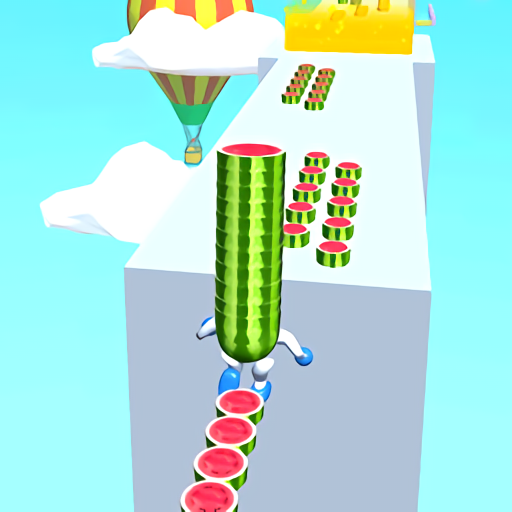
DESCRIPTION
Author

Watermelon Run (often appearing under titles like Watermelon Run 3D or Fruit Merge Runner) is a hyper-casual mobile game that cleverly mashes up two massively popular gaming trends: the traditional 3D endless obstacle runner and the viral fruit-merging mechanics of the Suika Game (Watermelon Game). Instead of dropping fruits into a static box, you take control of a rolling fruit hurtling down a vibrant obstacle course. Your goal is to navigate the track, absorb matching fruits to evolve your character into increasingly larger shapes, and eventually cross the finish line as a massive, unstoppable watermelon. If you enjoy simple, satisfying games that combine quick reflexes with visual progression, this fruit-filled dash is an excellent time-killer.
Gameplay Overview
The core loop of Watermelon Run is built around forward momentum, quick lane-switching, and the familiar "2048-style" puzzle progression.
The Merge-Runner Mechanic
The game starts you off as a tiny, low-tier fruit, such as a cherry or a strawberry. As your fruit rolls forward automatically, you must swipe left or right to steer it toward identical fruits scattered along the track. When two matching fruits collide, they instantly merge and "level up" into the next fruit in the evolutionary chain (e.g., two strawberries make a grape, two grapes make a lemon, and so on).
It is not just about collecting fruit; the track is littered with hazards. You will encounter spike traps, saw blades, and negative "subtraction gates" that will chop your giant melon back down into a tiny cherry—or destroy you completely. The challenge lies in weaving through these narrow gaps while still trying to maintain your trajectory toward the fruits you need to merge.
The Finish Line Multiplier
The size of your fruit matters immensely at the end of the level. The finish line usually consists of a multiplier ramp, a giant scale, or a boss character to crush. A small fruit will barely make a dent and earn you minimal coins, but a fully evolved watermelon will smash through barriers, rocketing your score and currency payout to the maximum limit.
What Makes Watermelon Run Special?
In a saturated market of hyper-casual runners, this title stands out by successfully adapting a trending puzzle mechanic into a high-speed action format.
Capitalizing on Viral Trends
The game acts as a bridge between the classic runner genre and the Suika Game craze that dominated the internet. By utilizing the exact same fruit evolution hierarchy (and often very similar cute, expressive faces on the fruit), it leverages the brand recognition of a viral hit to make its gameplay instantly intuitive for millions of players.
ASMR and Visual Feedback
Much of the game's appeal comes from its sensory feedback. The visual pop of two fruits merging, accompanied by a satisfying "squish" sound effect, creates an ASMR-like experience. Watching your tiny cherry gradually snowball into a screen-filling watermelon provides a highly tangible, satisfying sense of growth.
Low-Stakes Accessibility
The game features incredibly simple controls—just a single finger dragging left or right. There are no complex stats to manage, and the levels are usually only 30 to 60 seconds long. This makes it an incredibly low-friction game, perfect for a quick mental break or for keeping younger players entertained without frustration.
Pros & Cons
Pros
- Highly satisfying visual progression and ASMR-style audio feedback.
- Instantly understandable mechanics that blend puzzle-merging with reflexes.
- Very intuitive, simple one-finger drag controls.
- Short, bite-sized levels that are perfect for brief gaming sessions.
Cons
- As a quintessential hyper-casual game, the frequency of unskippable video ads can severely disrupt the pacing.
- The gameplay loop is inherently repetitive; the core track layouts and obstacles rarely evolve significantly.
- It lacks a deep meta-progression system, meaning long-term engagement is relatively low.
Tips for New Players
Memorize the Fruit Hierarchy
In the heat of a fast-paced run, you do not have time to guess. Memorize the basic evolution order (Cherry > Strawberry > Grape > Lemon > Orange > Apple > Peach > Pineapple > Melon > Watermelon). Knowing exactly what your fruit will turn into next allows you to anticipate which lane you need to shift toward without hesitating.
Prioritize Safety Over Small Merges
It is tempting to try and grab every single fruit on the track, but greed will often get you killed. If grabbing a cherry means risking a collision with a saw blade that will slice your current pineapple in half, let the cherry go. Preserving your size is always more important than a minor upgrade.
The "Offline" Trick
If you find that the pop-up advertisements between every single level are ruining your zen experience, try turning off your device's Wi-Fi and Cellular Data before opening the app. This blocks the game's ability to load ads, allowing you to run and merge in peace (though you won't be able to access ad-reliant bonuses like free revives or multiplier boosts).
Final Verdict
Watermelon Run is a delightful, fast-paced distraction that perfectly captures the satisfying nature of merge-puzzles and injects it with a dose of adrenaline. It doesn't challenge you with deep narratives or complex skill trees; instead, it provides a colorful track where you can zone out, dodge some spikes, and build the ultimate giant fruit. While the heavy ad monetization is a frustrating reality of its genre, the core experience is a fantastic, pocket-sized stress reliever for anyone who enjoys a simple, visually rewarding challenge.